Rahul Gandhi Moves Supreme Court as Former Judge K
October 14, 2026

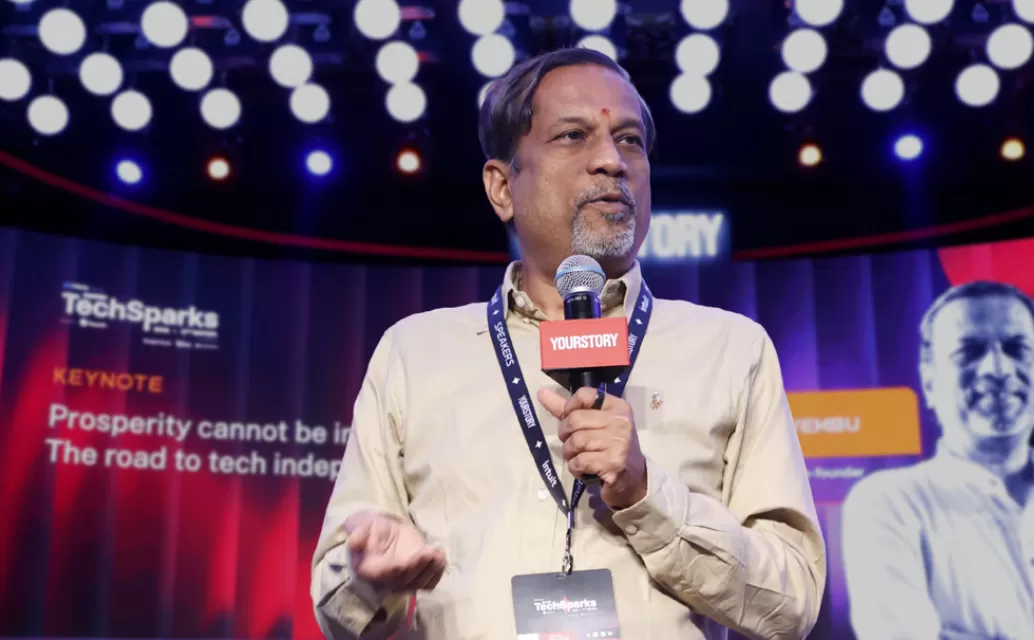
At TechSparks 2026, Zoho co-founder and chief scientist Sridhar Vembu warned that rapid advances in artificial intelligence could transform software development, while emphasizing that India's long-term prosperity depends on technology ownership, domestic hardware and technological self-reliance.
Artificial intelligence is advancing rapidly, and traditional software development could face a major transformation in the coming months. Speaking at the 17th edition of YourStory's TechSparks event, Sridhar Vembu, co-founder and chief scientist of Zoho, suggested that AI systems could outperform a large majority of software engineers in writing code within the next three to six months.
Vembu compared traditional software development to the handloom industry, where manual production faces competition from powerful automated machinery. In his view, AI-powered systems are increasingly capable of producing complex software quickly and efficiently.
However, his message extended beyond the future of coding jobs. He argued that India's more important challenge is to develop and own the technologies that drive economic growth instead of depending heavily on foreign intellectual property and infrastructure.
According to Vembu, AI systems can already write better code than a substantial proportion of software engineers. He estimated that, if current progress continues, AI could outperform around 90% of software engineers in software creation within three to six months.
His comments highlight the growing capabilities of AI coding assistants and automated software development systems, which can help developers generate code, identify errors, create tests and build applications.
The comparison with handloom production illustrates the potential scale of this change. Just as mechanized looms transformed textile manufacturing, AI tools could change how software is developed, maintained and delivered.
However, outperforming a developer at writing code does not necessarily mean replacing every aspect of software engineering. Requirements analysis, architecture, security, testing, system integration, accountability and understanding business needs remain important parts of software development.
The broader implication is that developers may need to adapt their skills as AI becomes more capable.
The rapid development of AI has raised concerns about employment opportunities for software engineers, particularly in countries such as India, where IT services and software outsourcing play a significant economic role.
Vembu offered a broader perspective on the issue. He noted that most people in the population do not write software professionally, meaning the direct impact of automated coding may be concentrated initially in particular industries and occupations.
He also suggested that falling software production costs could reduce expenses across the economy. If businesses can develop and operate software more cheaply, some of those savings could eventually benefit consumers through lower prices or more affordable services.
Nevertheless, the effect on employment and prices will depend on how businesses adopt AI, whether new jobs emerge and how productivity gains are distributed.
For software professionals, the practical response is to learn how to use AI tools effectively while strengthening skills that extend beyond routine code generation.
One of Vembu's central arguments was that India's economic progress should not be measured only by the number of engineers employed by global technology companies.
Indian engineers contribute to products and services developed by multinational companies, but the intellectual property, product ownership and associated financial returns may remain with the companies that own those technologies.
Vembu argued that this distinction matters because ownership of technology can influence how economic value is distributed throughout a country, including among people who do not work directly in the technology industry.
He illustrated the issue by comparing the purchasing power of teachers in Switzerland and India. The comparison was intended to emphasize that national income levels and productivity affect ordinary workers, not only software engineers and technology entrepreneurs.
His argument is that India needs more globally competitive technology products, patents, infrastructure and businesses that it owns and develops domestically.
Vembu pointed to East Asian economies, including Japan, South Korea, Taiwan and China, as examples worth studying for their development of industrial and technological capabilities.
His argument is that India should not focus exclusively on the most visible applications of artificial intelligence. It should also build the foundational systems required to support advanced technology.
China's domestic digital ecosystem, including services such as Baidu and WeChat, illustrates how local technology platforms can become important parts of a country's digital infrastructure.
For India, the challenge is to develop competitive domestic alternatives and capabilities while remaining connected to global research, markets and supply chains.
The goal, in this view, is not simply to use advanced technology but to possess the ability to build, maintain and improve it independently.
Vembu cautioned against concentrating too heavily on AI applications while overlooking the infrastructure and industrial technologies on which they depend.
Foundational areas he highlighted include:
Semiconductors and computing infrastructure: Essential for running modern software and AI systems.
Operating systems: Important for controlling core computing environments.
Robotics: Useful in manufacturing, logistics, agriculture and other industries.
Lasers and X-ray technologies: Relevant to scientific research, healthcare and industrial applications.
Agricultural technology: Important for improving productivity and supporting India's agricultural economy.
Domestic server infrastructure: Helps build technical capability and reduce dependence on external suppliers.
Developing these capabilities requires long-term investment, research, skilled workers, reliable supply chains and cooperation between industry, academia and government.
Vembu also discussed how rising demand for AI infrastructure is affecting technology companies.
According to the supplied report, the cost of servers has increased significantly, with prices rising from approximately $8,000 to $45,000. Such increases can create pressure on companies investing in computing infrastructure.
Rather than treating AI primarily as a reason to reduce headcount, Vembu said Zoho was redeploying engineering talent towards deeper technology challenges, including building server infrastructure internally.
This approach reflects a different way of responding to automation. Employees whose existing tasks become easier to automate may be able to contribute to new projects involving hardware, infrastructure, research and product development.
For companies, the strategy depends on whether they can identify valuable new work and provide employees with the training and resources needed to perform it.
Vembu's comments provide several practical lessons for software professionals, students and technology businesses.
Developers should become familiar with AI-assisted coding, debugging, documentation and testing. Understanding when AI output is reliable—and when it needs careful review—is increasingly important.
Knowledge of data structures, algorithms, databases, operating systems, networking, cybersecurity and software architecture helps developers evaluate and improve AI-generated code.
Problem-solving, system design, domain knowledge, product thinking and communication can help developers contribute more than code generation alone.
Cloud computing, distributed systems, embedded systems, robotics, semiconductor technology and hardware-software integration can provide additional directions for technical learning.
Entrepreneurs and engineering teams can focus on solving real problems, developing differentiated products and creating sustainable intellectual property.
Sridhar Vembu's comments at TechSparks 2026 highlight two connected changes: AI is reshaping software development, and technological ownership may become increasingly important to economic competitiveness.
The possibility that AI could outperform a large share of coders is a forecast, not a guarantee that 90% of software engineers will lose their jobs. The actual impact will depend on AI capabilities, business adoption and the emergence of new kinds of work.
For India, the broader challenge is to combine AI adoption with investment in hardware, foundational research, domestic products and technology ownership. For developers, the opportunity is to adapt, deepen their technical knowledge and learn to build systems that use AI effectively.
Follow GlobalFamily.in for technology news, AI developments, career insights and opportunities. Let's Support Each Other.

October 14, 2026

October 14, 2026

October 14, 2026

October 14, 2026

October 14, 2026

October 14, 2026

October 14, 2026

October 14, 2026

October 14, 2026
October 14, 2026
No comments yet. Be the first to comment.