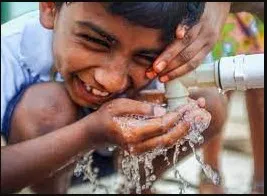
The National Rural Drinking Water Programme (NRDWP) is a flagship initiative of the Government of India aimed at providing safe and adequate drinking water supply to rural areas across the country. Here is some point-to-point information about the NRDWP:
1. Objective: The main objective of the NRDWP is to provide every rural person with access to safe and adequate drinking water for daily consumption and other domestic needs.
2. Implementation: The programme is implemented by the Ministry of Jal Shakti, Government of India, in collaboration with state governments and other stakeholders. It is executed at the village level by the Gram Panchayats (village councils).
3. Coverage: The NRDWP covers all rural areas of India, including villages and hamlets. It focuses on areas facing water scarcity, water quality issues, and regions affected by natural disasters.
4. Financial Support: The central government provides financial assistance to the states and union territories for implementing the NRDWP. The funding pattern is 50:50 for normal states and 90:10 for northeastern and Himalayan states.
5. Components: The programme consists of various components, including:
a. Water Supply Infrastructure: This includes the creation of drinking water sources such as hand pumps, tube wells, dug wells, and piped water supply schemes.
b. Water Quality Monitoring: Regular monitoring of water quality is conducted to ensure that the water supplied is safe for consumption. Testing labs and facilities are set up for this purpose.
6. Technology Options: The NRDWP promotes the use of appropriate and sustainable technologies for drinking water supply, such as hand pumps, rainwater harvesting, solar-powered water supply systems, and community water purification units.
7. Convergence: The NRDWP encourages convergence with other related government schemes like the Swachh Bharat Mission (SBM), Mahatma Gandhi National Rural Employment Guarantee Scheme (MGNREGS), and National Health Mission (NHM) to ensure holistic development and maximum impact.
8. Monitoring and Evaluation: Regular monitoring and evaluation of the programme's progress and impact are undertaken at various levels, including national, state, and district levels. Feedback mechanisms and grievance redressal systems are put in place to address any issues or concerns.
9. Achievements: Over the years, the NRDWP has made significant progress in improving rural drinking water supply. It has increased the coverage of piped water supply, reduced waterborne diseases, and improved the overall quality of drinking water in rural areas.
10. Future Plans: The NRDWP aims to further strengthen its efforts in achieving the goal of providing every rural household with a functional household tap connection (FHTC) for drinking water supply. The program also focuses on sustainability, ensuring long-term operation and maintenance of water supply systems.
It's important to note that while the information provided here is accurate as of my knowledge cutoff in September 2021, there may have been updates or changes to the programme since then. For the latest and most accurate information, it is recommended to refer to official government sources or the Ministry of Jal Shakti's website.